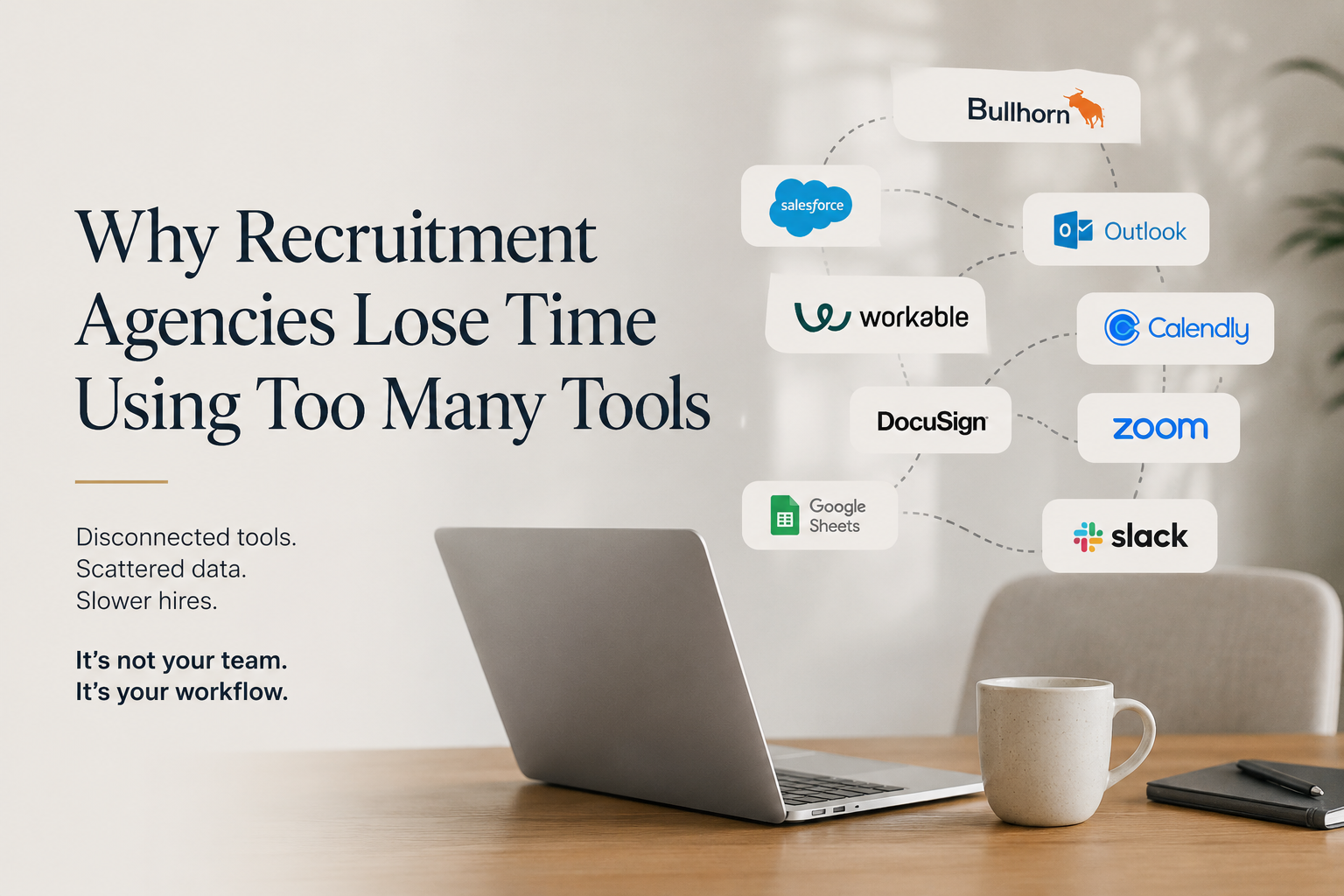
Many recruitment agencies do not have a people problem. They have a workflow problem.
Recruiters are often expected to manage candidates, clients, emails, interviews, references, reports, job boards, analytics and shortlist presentations across several disconnected tools.
This article explains why fragmented recruitment software slows agencies down, what it costs in daily work, and why an all-in-one recruitment operating system can help agencies work smarter, spend wiser and hire better.
Recruitment agencies manage a lot at once.
They need to win clients, understand roles, source candidates, screen profiles, arrange interviews, manage feedback, check references, prepare shortlists, update clients and close placements.
That is already a complex workflow.
But for many agencies, the real problem is not the recruitment process itself.
The real problem is that the process is split across too many tools.
One system for the ATS.
One system for CRM.
One tool for email.
One tool for video interviews.
One spreadsheet for candidate comparison.
One document for client briefings.
One platform for reports.
One manual process for references.
The recruiter is not simply recruiting anymore.
They are stitching systems together all day.
Recruitment software fragmentation happens when an agency uses too many disconnected tools to manage one recruitment workflow.
Each tool may be useful on its own.
The problem starts when none of them speak clearly to each other.
Candidate data sits in one place.
Client communication sits somewhere else.
Interview notes are stored separately.
Reference checks are handled manually.
Shortlist presentations are built outside the recruitment platform.
Reports are created after the work has already happened.
That creates more admin, more duplication and more risk.
Fragmented software affects recruitment agencies in practical ways.
It is not just annoying.
It changes how fast and how professionally the agency can operate.
Every time a recruiter moves from one tool to another, they lose focus.
They check the ATS, open email, look at a spreadsheet, return to the candidate record, search for client feedback, then prepare a document manually.
Individually, these actions seem small.
Together, they take hours.
The more tools the agency uses, the more time recruiters spend managing the process instead of moving the process forward.
Recruitment depends on context.
A note from a client can change how a candidate is presented.
An interview comment can change the shortlist.
A reference concern can change the recommendation.
But when information is scattered across emails, messages, documents and spreadsheets, the agency can lose the full picture.
The result is weaker decision-making.
Candidates notice when the process feels disorganised.
They may receive repeated questions.
They may wait too long for updates.
They may speak to different people who do not have the same information.
They may feel that the agency is reactive instead of in control.
A better internal workflow creates a better candidate experience.
Many agencies work hard to find good candidates, but then present them with basic CV forwarding or rushed summaries.
That is a missed opportunity.
Clients do not only need names.
They need clarity.
They need to understand why each candidate fits, how the finalists compare, what risks exist and what the recruiter recommends.
When shortlist preparation happens outside the recruitment system, it often becomes manual, inconsistent and time-consuming.
Owners and managers need to understand what is happening across the business.
Which jobs are active?
Which clients are moving?
Which recruiters are progressing candidates?
Where are delays happening?
Which stages are creating the most friction?
If data is spread across multiple tools, visibility becomes weaker.
The agency may be busy, but not clearly measurable.
The cost of fragmentation is not only software subscriptions. Recruiters spend more hours updating systems instead of recruiting. The same information has to be entered in several places. Agency owners cannot easily see the full workflow. Recruiters need to collect information from different tools before replying. Candidates receive a less organised and less consistent process. Reports are built after the fact instead of inside the workflow. Candidate recommendations become less structured and less persuasive. Agencies pay for several tools instead of one connected platform.Fragmentation makes recruitment feel heavier than it should.
Recruitment agencies should not choose software only by asking, “Does it have an ATS?”
That is too narrow.
A modern recruitment agency needs a connected workflow.
The better question is:
“Can this platform help us manage the full recruitment process from candidate management to client presentation?”
Agencies should look for:
Candidate and client management should be connected. Recruiters need faster screening and better candidate comparison. Messages and updates should stay close to the candidate record. Interview content should become usable recruitment intelligence. Reference checks should be structured and risk-aware. Candidates should have a professional branded experience. Owners need visibility over performance and pipeline. Shortlists should be presented clearly and professionally. Growth should not create unnecessary licence pressure.All-in-one recruitment software is not about adding features for the sake of it.
It is about reducing friction.
When the key parts of the workflow live inside one platform, the agency can move faster and with more control.
Recruiters spend less time searching for information.
Managers see more of what is happening.
Candidates receive a clearer experience.
Clients receive stronger presentations.
The agency becomes less dependent on disconnected tools and manual workarounds.
That is the real value.
Executive Hunter is an AI-native recruitment operating system built for agencies.
It brings ATS/CRM, built-in AI matching, multilingual CV parsing, reference intelligence and fraud detection, video interviews, branded candidate portal and messaging, interview intelligence, analytics, activity tracking, client folders, agent permissions and Briefing Studio into one platform.
The goal is simple:
one platform, one workflow, one clearer way to run the agency.
Executive Hunter helps agencies reduce fragmentation by connecting the key stages of recruitment inside a single operating system.
From sourcing and candidate management to reference checks, interviews, analytics and client-ready briefings, the platform is designed to support the full agency workflow.
And because Executive Hunter does not use per-seat pricing, agencies can grow their team without turning every new user into another licence decision.
Executive Hunter approach: ATS and CRM together. Executive Hunter approach: AI-supported matching and structured candidate insights. Executive Hunter approach: Video interviews and interview intelligence built in. Executive Hunter approach: Reference intelligence and fraud detection. Executive Hunter approach: Branded candidate portal and messaging. Executive Hunter approach: Briefing Studio for structured client presentations. Executive Hunter approach: Analytics and activity tracking inside the system. Executive Hunter approach: No per-seat pricing.Recruitment agencies do not need more disconnected software.
They need a better-connected recruitment workflow.
If your recruiters are constantly switching between tools, copying information, chasing updates and building reports manually, the problem may not be your team.
The problem may be the system around them.
Executive Hunter was built for agencies that want to reduce fragmentation, improve visibility and deliver a more professional recruitment process from start to finish.
Explore Executive Hunter and see how one recruitment operating system can replace disconnected tools.