That makes sense, because agencies need to manage both candidates and clients.
But modern recruitment work goes beyond ATS and CRM.
Agencies also need AI matching, CV parsing, candidate communication, video interviews, reference checks, analytics, activity tracking, candidate portals and client briefing reports.
This is why many agencies are starting to look beyond traditional recruitment software and ask a bigger question:
Do we need an ATS, a CRM, or a complete recruitment operating system?
Recruitment agencies do not work with only one side of the market.
They work with candidates and clients at the same time.
Candidates need to be sourced, screened, contacted, interviewed, compared and presented.
Clients need to be managed, updated, advised and supported through the hiring process.
That is why both ATS and CRM matter.
An ATS helps agencies manage the candidate side.
A CRM helps agencies manage the client and business development side.
But if those two areas are not connected properly, recruiters lose time and context.
A candidate may be strong for one client today and useful for another client tomorrow.
A client conversation may change the way a shortlist is prepared.
A note from a hiring manager may affect how candidates are assessed.
Recruitment does not happen in isolated boxes.
Candidate management and client management should work together.
ATS stands for Applicant Tracking System.
In recruitment, an ATS helps agencies manage jobs, candidates, applications and pipeline stages.
It gives recruiters a place to store candidate information, track progress, manage CVs and understand where each candidate sits in the process.
For many agencies, the ATS is the foundation of recruitment software.
It helps answer questions like:
Who applied?
Who was sourced?
Who has been screened?
Who is shortlisted?
Who has been submitted to the client?
Who is waiting for feedback?
This is essential.
Without an ATS, agencies can quickly lose control of candidate movement and job activity.
But an ATS alone is not enough.
It may help manage candidates, but it does not always support the full agency workflow.
CRM stands for Customer Relationship Management.
For recruitment agencies, CRM usually means managing clients, companies, contacts, sales activity, business development and relationship history.
A recruitment CRM helps agencies track client conversations, job opportunities, decision-makers, meetings, follow-ups and commercial activity.
This matters because recruitment agencies do not only deliver candidates.
They also build relationships.
A strong CRM helps agencies understand which clients are active, which companies are warm, which contacts need follow-up and where new business may come from.
But just like an ATS, a CRM alone is not enough.
A CRM can help manage the client relationship, but it does not always manage the recruitment delivery process.
Many agencies ask:
“Do we need an ATS or a CRM?”
But for recruitment agencies, the real answer is usually: you need both.
The better question is not ATS vs CRM.
The better question is:
How connected is the workflow?
If the ATS and CRM are separate, recruiters still need to jump between systems.
If candidate data sits in one place and client activity sits somewhere else, the agency loses visibility.
If client feedback is not connected to candidate progress, the shortlist becomes harder to manage.
If business development is not connected to live jobs and candidate pipelines, owners see only part of the picture.
Recruitment agencies need candidate and client data to work together.
That is where a recruitment operating system becomes more useful.
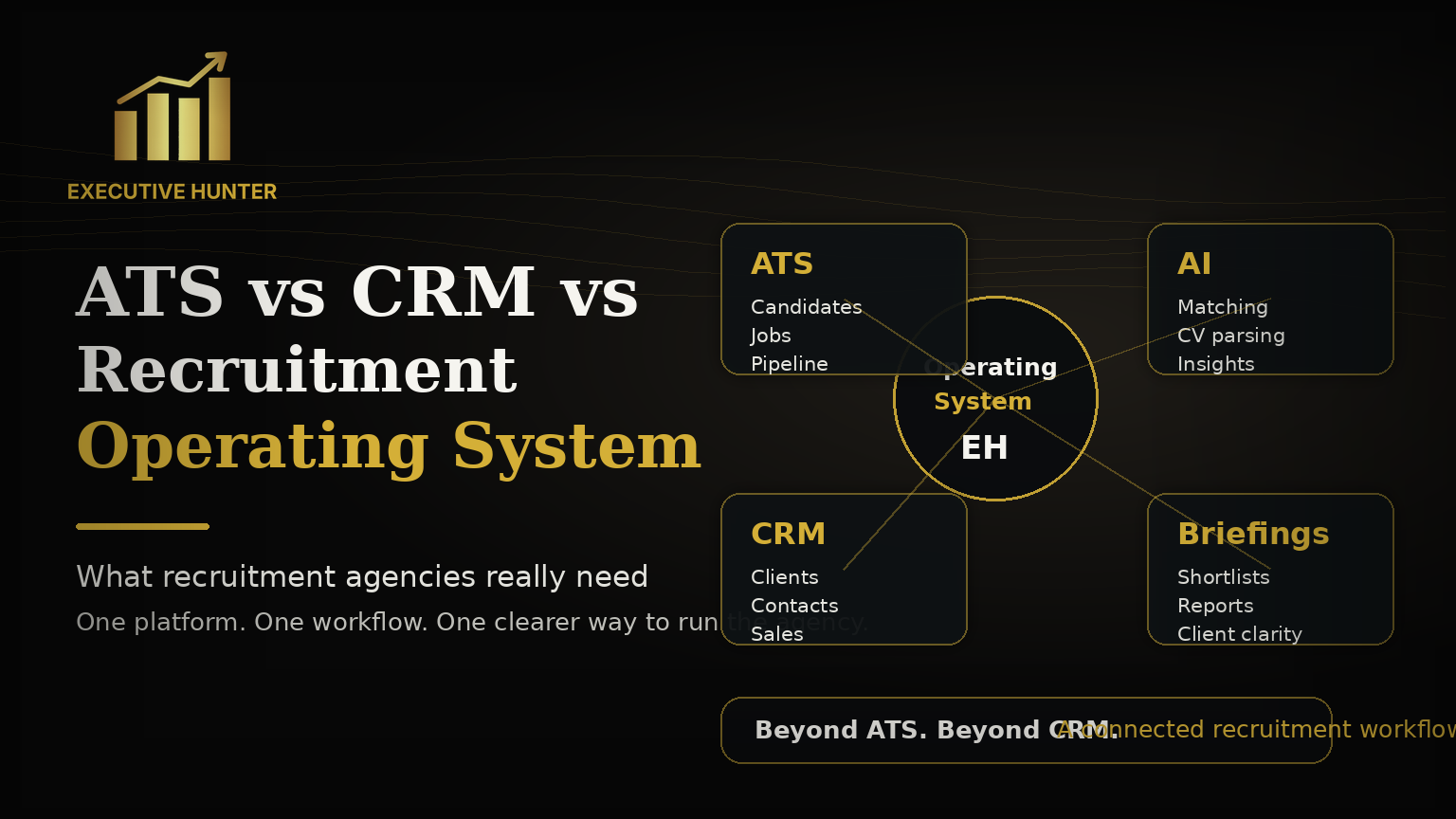
A recruitment operating system is broader than an ATS or CRM.
It is not just a database for candidates.
It is not just a sales tool for clients.
It is a connected workspace that supports the full recruitment workflow.
A recruitment operating system helps agencies manage the process from first contact to final presentation.
That can include candidate management, client management, AI matching, CV parsing, communication, interviews, references, candidate portals, analytics, reporting and client briefing documents.
The point is not to add more features for the sake of it.
The point is to reduce fragmentation.
Recruiters should not need one tool for candidates, one tool for clients, one tool for emails, one tool for interviews, one tool for references, one spreadsheet for comparisons and one document template for client reports.
A recruitment operating system brings the workflow together.
A small agency may start with a basic ATS or CRM and feel that it is enough. At the beginning, the process may be manageable. There are fewer clients, fewer candidates, fewer roles and fewer team members. But as the agency grows, the workflow becomes more complex. More recruiters need access. More candidates need to be tracked. More clients need updates. More interviews need to be managed. More references need to be checked. More reports need to be created. More owners and managers need visibility.This is when basic tools can start to feel limited.
The agency may still have an ATS and CRM, but the real work is happening outside them.
Candidate comparisons are built manually.
Client briefings are prepared in separate documents.
Reference checks are handled by email.
Interview insights are not properly connected to the candidate record.
Analytics are incomplete.
The platform may technically exist, but the workflow is still fragmented.
Disconnected tools create hidden costs.
They make recruiters repeat work.
They make updates slower.
They make reporting less reliable.
They make candidate communication harder to track.
They make client presentations less consistent.
They also make it harder for agency owners to see what is really happening.
The agency may look busy, but the workflow is not clear.
Information is moving, but not always in one place.
Recruiters are working, but they are also constantly stitching systems together.
This is why choosing software should not only be about features.
It should be about workflow.
Recruitment agencies need a platform that supports how they actually work.
They need ATS and CRM together.
They need AI that helps with matching, parsing and candidate understanding.
They need candidate communication connected to the process.
They need video interviews that can produce useful insights.
They need reference intelligence to support validation and risk detection.
They need a candidate portal that gives candidates a professional experience.
They need analytics and activity tracking so owners can see what is happening.
They need client briefing reports that help recruiters present candidates clearly.
And they need pricing that supports growth, not pricing that makes every new user feel like another cost problem.
This is why the conversation is moving beyond ATS vs CRM.
The real need is a connected recruitment operating system.
Many recruitment platforms focus heavily on managing candidates before they are submitted.
But one of the most important moments in recruitment happens after the shortlist is ready.
That is when the recruiter presents candidates to the client.
A client does not only need CVs.
They need clarity.
They need to understand why each candidate has been selected, how the finalists compare, what concerns exist and what the recruiter recommends.
This is where many agencies still rely on manual documents, spreadsheets and rushed summaries.
That can weaken the agency’s value.
A stronger recruitment platform should help agencies present candidates professionally, not just store their profiles.
This turns recruitment from simple CV delivery into a more advisory service.
References are still a critical part of recruitment.
But in many agencies, reference checking remains manual and inconsistent.
For senior roles, international hiring or sensitive positions, that can create risk.
A recruitment operating system should help agencies collect, structure and review reference information more intelligently.
It should also help identify possible red flags, inconsistencies or suspicious patterns.
This gives agencies more confidence before candidates are presented or placed.
It also helps protect client trust.
Pricing is often treated as a finance issue.
For recruitment agencies, it is also a workflow issue.
If every new recruiter, researcher, coordinator or manager creates another licence cost, the agency may limit who gets access.
That can create internal blind spots.
Researchers may work outside the platform.
Managers may not see live activity.
Support staff may need to ask for updates instead of checking directly.
The agency may save money in one place but lose efficiency somewhere else.
A recruitment operating system should make it easier for agencies to grow, not make growth feel more expensive every time the team expands.
Executive Hunter is an AI-native recruitment operating system built for agencies.
It brings ATS/CRM, built-in AI matching, multilingual CV parsing, reference intelligence and fraud detection, video interviews, branded candidate portal and messaging, interview intelligence, analytics, activity tracking, client folders, agent permissions and Briefing Studio into one platform.
The goal is simple:
one platform, one workflow, one clearer way to run the agency.
Executive Hunter is not only an ATS.
It is not only a CRM.
It is designed to connect the key parts of the recruitment workflow, from candidate and client management to interviews, references, analytics and client-ready candidate briefings.
And because Executive Hunter does not use per-seat pricing, agencies can grow their team without turning every new user into another licence decision.
The recruitment operating system approach starts from a simple idea:
recruitment agencies should not need to build their workflow from disconnected tools.
They should not need to manage candidates in one place, clients in another, interviews elsewhere, references manually and briefing reports outside the platform.
Executive Hunter brings those stages together.
This helps recruiters work with more context.
It helps owners see more of the business.
It helps candidates experience a more organised process.
It helps clients receive clearer, more professional presentations.
For agencies that want to grow, reduce fragmentation and deliver a stronger recruitment service, this approach can be more useful than choosing between ATS and CRM alone.
ATS and CRM are both important.
But recruitment agencies need more than two databases.
They need a connected workflow.
They need a platform that supports candidates, clients, communication, interviews, references, analytics and client presentations in one place.
That is why the real question is no longer:
“Do we need an ATS or a CRM?”
The better question is:
“Do we need a recruitment operating system?”
For agencies that want one clearer way to manage the recruitment workflow, Executive Hunter was built for exactly that.