But trust alone is not enough.
Recruitment agencies often rely on references to confirm a candidate’s experience, behaviour, reliability and past performance. Yet references can be incomplete, vague, inconsistent or, in some cases, misleading.
That is why agencies need more than basic reference collection.
They need reference intelligence
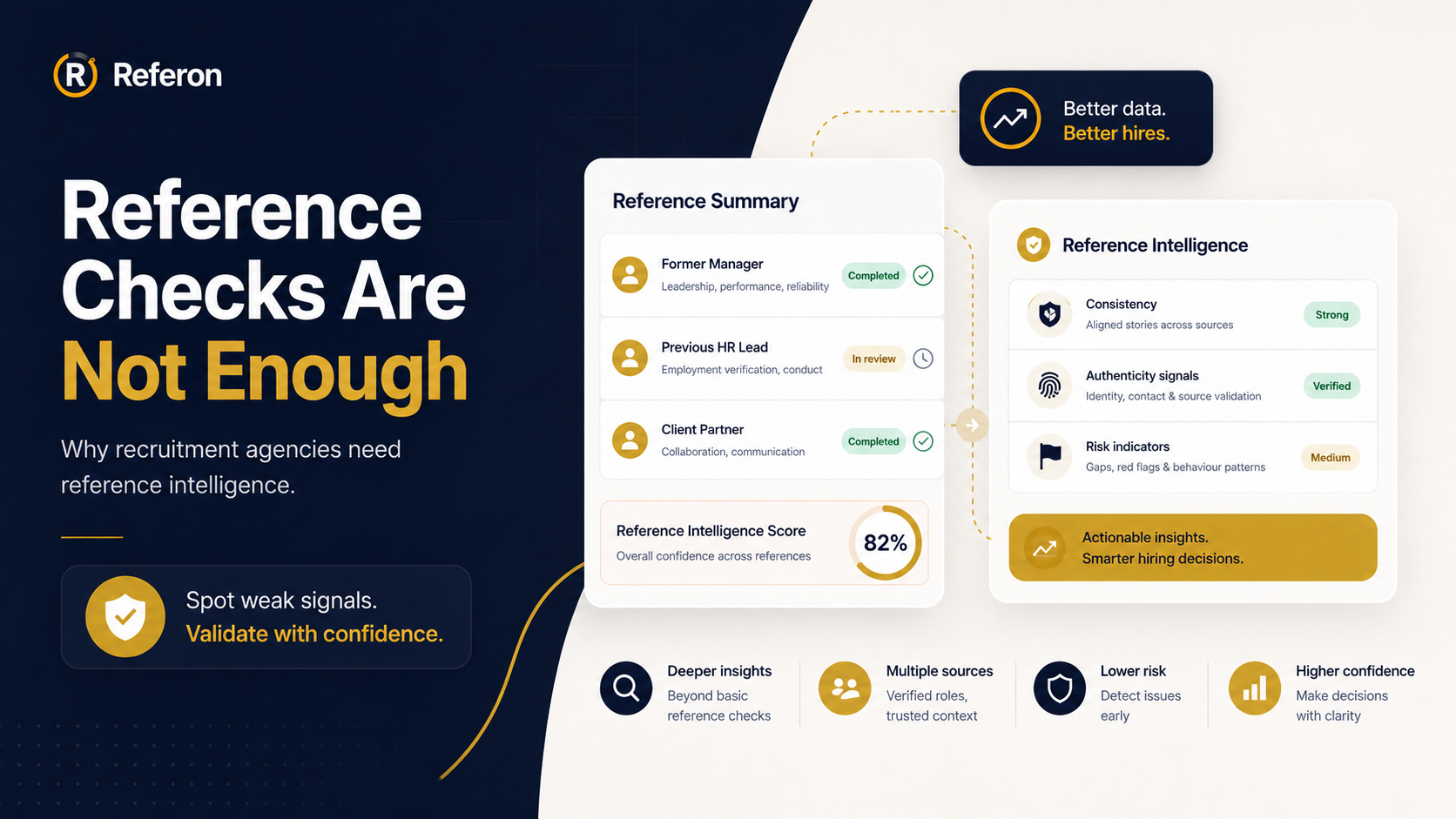
ReferOn Detector helps recruitment agencies review reference responses more carefully, identify weak signals, detect inconsistencies and spot possible fraud indicators before a candidate reaches the client.
Recruitment is built on judgement.
A recruiter can review a CV, interview a candidate, compare experience and assess fit, but there is still one important question:
Does the candidate’s professional history hold up when checked?
That is why reference checks continue to matter.
They help agencies understand how a candidate performed in previous roles, how they worked with managers or colleagues, whether their experience matches what they claimed and whether there are any concerns that should be explored before a recommendation is made.
For clients, references can add confidence.
For agencies, they can protect reputation.
For candidates, they can support credibility.
But only if the reference process is handled properly.
Many reference checks still happen in a very manual way.
A recruiter sends an email, makes a phone call, collects answers, adds notes to a document and moves on.
Sometimes this is enough.
But often, the process is too light.
The recruiter may receive answers that sound positive but say very little.
The reference may avoid specific details.
The tone may feel inconsistent.
The dates may not match the candidate’s CV.
The role described may not match what the candidate claimed.
The reference may come from a personal contact rather than a proper professional source.
Or the same style of language may appear across different references.
Individually, these signs may not prove anything.
Together, they can suggest that the reference deserves closer attention.
Traditional reference checks often depend too heavily on trust and instinct.
Reference intelligence adds structure.
Reference intelligence means looking beyond the surface of a reference response.
It is not only about collecting an answer.
It is about understanding the quality, consistency and reliability of that answer.
A reference intelligence process helps recruiters ask better questions, review responses more carefully and identify possible signals that require follow-up.
These signals may include vague answers, inconsistent timelines, unusual wording, weak identity indicators, incomplete employment details, suspicious patterns or differences between the reference and the candidate’s own information.
The goal is not to accuse.
The goal is to validate.
Recruitment agencies need to know when a reference strengthens a candidate’s profile and when it creates questions that should be checked before the candidate is presented to a client.
A weak reference is not always fraudulent.
Sometimes a referee is simply busy.
Sometimes they do not want to share much.
Sometimes company policy limits what they can say.
But weak, vague or inconsistent references can still create risk.
If a recruitment agency presents a candidate without checking the quality of the reference properly, the client may later discover problems that could have been noticed earlier.
That can damage trust.
It can make the agency look careless.
It can create doubts about the quality of the shortlist.
In recruitment, reputation is built slowly and damaged quickly.
That is why agencies need a stronger way to handle references, especially for roles where trust, responsibility, seniority or compliance matter.
Collecting a reference means receiving information.
Analysing a reference means understanding what that information is really worth.
A reference may be positive but too generic.
It may confirm employment but not performance.
It may praise the candidate but avoid measurable details.
It may use language that sounds polished but lacks substance.
It may create small contradictions when compared with the CV, interview notes or employment timeline.
Recruiters need a way to separate useful references from weak references.
This is where ReferOn Detector becomes valuable.
ReferOn Detector is designed to help recruitment agencies review references with more structure and more caution.
It helps identify weak signals, inconsistencies and possible fraud indicators inside reference responses.
The aim is not to replace the recruiter’s judgement.
The aim is to support it.
Recruiters still make the decision.
ReferOn Detector helps them see what may deserve a closer look.
It gives agencies a stronger reference intelligence layer before candidates are presented to clients.
ReferOn Detector can support the review of several areas that matter in reference validation.
A reference should broadly match the candidate’s own information.
If employment dates, responsibilities, reporting lines or role descriptions do not match, recruiters may need to investigate further.
Not every mismatch means fraud.
But every unexplained mismatch deserves attention.
References should feel connected to a real professional relationship.
If a response is too vague, too generic or unusually similar to another reference, it may be worth checking more carefully.
A strong reference usually gives context.
It explains how the referee knew the candidate, what the candidate did and how they performed.
A candidate may describe a role in one way, while the reference describes it differently.
That matters.
If the candidate claims senior responsibility but the reference suggests a smaller role, the recruiter needs to understand the gap.
The same applies to leadership, client exposure, project ownership, technical responsibility or management experience.
Some references contain signals that should not be ignored.
These may include inconsistent details, unclear identity, unusual wording patterns, missing context or answers that avoid direct questions.
ReferOn Detector helps agencies notice these signals before they become a client problem.
Recruitment agencies are not only judged by whether they find candidates.
They are judged by the quality of their process.
A client expects the agency to screen properly, assess carefully and present candidates with confidence.
If a weak reference is missed, the client may question the agency’s judgement.
If a suspicious reference is accepted too easily, the agency may carry the risk.
Reference intelligence helps agencies protect the quality of their recommendations.
It gives recruiters more structure.
It gives clients more confidence.
It gives agency owners a stronger process.
Clients want to know that a candidate has been properly assessed.
They do not want only a CV.
They want context.
They want confidence.
They want to understand why the recruiter believes the candidate is suitable.
A stronger reference process supports that trust.
When an agency can say that references were not only collected, but reviewed with intelligence and caution, the recommendation becomes stronger.
This is especially important for executive search, specialist recruitment, international hiring and roles involving money, safety, leadership or sensitive access.
Reference checking should not sit outside the recruitment process.
If reference information is handled separately, it can become disconnected from the candidate record, interview notes and client briefing.
That weakens the workflow.
Reference information should be part of the candidate’s full evaluation.
It should connect with the CV, interview intelligence, recruiter notes, suitability analysis and client presentation.
This helps the agency make better decisions and present candidates with more clarity.
ReferOn Detector is part of the wider Executive Hunter approach to recruitment intelligence.
Executive Hunter is an AI-native recruitment operating system built for agencies.
It brings ATS/CRM, built-in AI matching, multilingual CV parsing, reference intelligence and fraud detection, video interviews, branded candidate portal and messaging, interview intelligence, analytics, activity tracking, client folders, agent permissions and Briefing Studio into one platform.
Within that workflow, ReferOn Detector helps agencies strengthen the reference stage.
It supports validation before the candidate reaches the client.
It helps recruiters avoid relying on trust alone.
And it connects reference intelligence with a broader recruitment operating system.
ReferOn Detector can also be used separately by agencies that want to strengthen their reference checks without changing their full recruitment platform immediately.
This makes it useful for recruiters and agencies that want a focused tool for reference intelligence, candidate verification and fraud signal detection.
For agencies already using Executive Hunter, ReferOn Detector becomes part of the wider workflow.
For agencies that only need reference intelligence, it can still add value on its own.
The value of ReferOn Detector is not that it makes decisions for recruiters.
It does not.
The value is that it helps recruiters ask better questions about the information in front of them.
Is this reference consistent?
Is it detailed enough?
Does it match the candidate’s timeline?
Does it support the candidate’s claims?
Are there weak signals that should be reviewed?
Does anything need follow-up before the client sees the candidate?
These questions help agencies move from basic reference checking to stronger reference intelligence.
Reference checks should not rely on trust alone.
Trust matters, but in recruitment, trust should be supported by validation.
Recruitment agencies need to protect their clients, their candidates and their own reputation.
That means treating references as more than a formality.
It means reviewing them carefully, looking for inconsistencies and understanding the quality of the information being received.
ReferOn Detector helps agencies do exactly that.
It gives recruiters a stronger way to review references, detect weak signals and build more confidence before recommending a candidate.
Because in recruitment, a reference should not only be collected.
It should be understood.