When a company decides to hire through an external recruiter, one of the first choices is the engagement model. Retained search and contingency search work in very different ways, and choosing the wrong one can slow a hire, raise its cost, or produce a shortlist that does not match the seniority of the role.
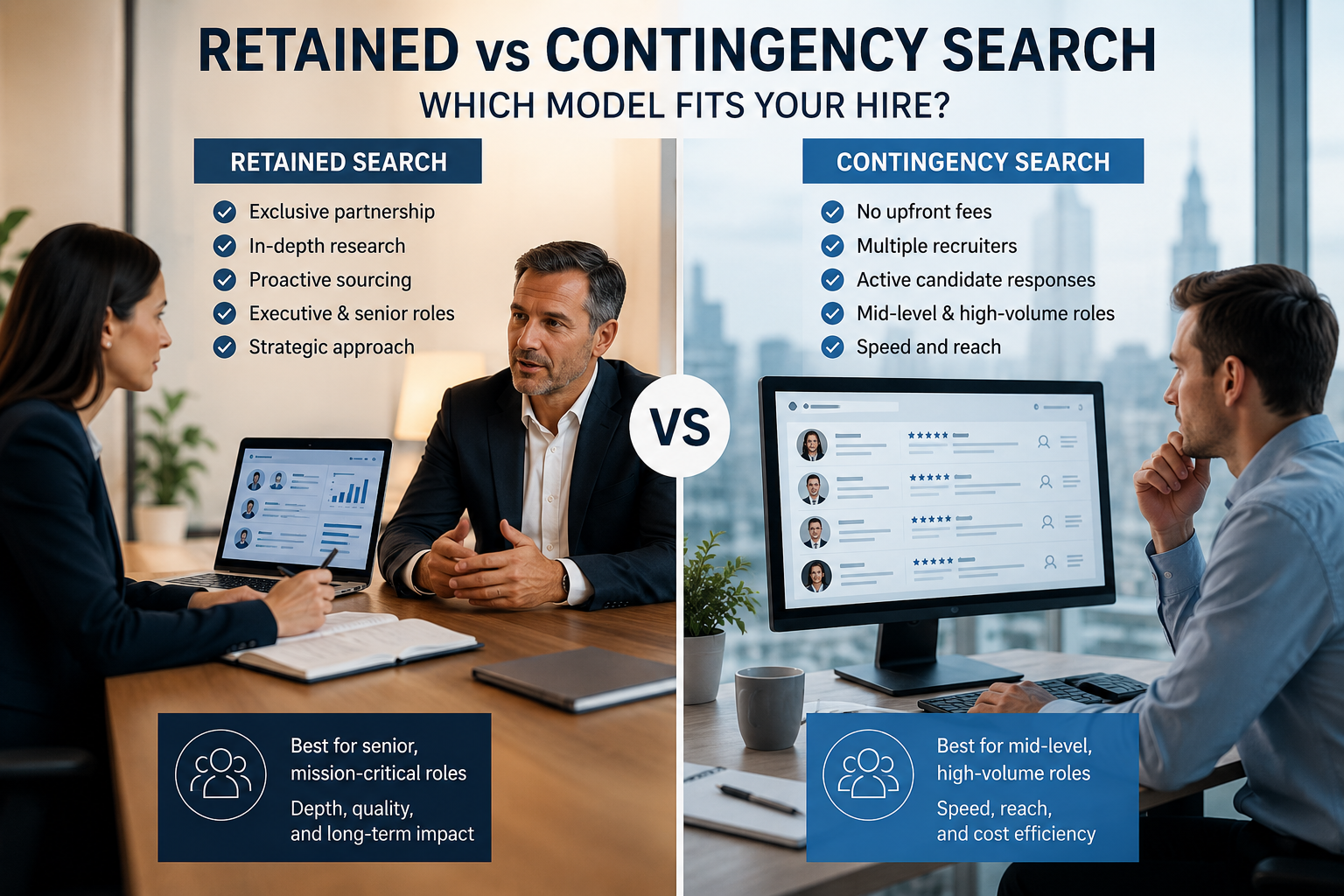
In contingency search, the recruiter is paid only when a candidate is successfully placed. There is no upfront fee, and several agencies may work the same role at the same time. The first to deliver a hired candidate earns the fee.
This model suits high-volume, mid-level roles where speed and reach matter more than depth.
In retained search, the client pays part of the fee upfront and commits to a single recruiter for the assignment. The recruiter is retained exclusively and works the role from start to finish.
This is the standard model for executive search and senior appointments, where the qualified pool is small, often passive, and requires a structured, confidential approach.
The two models differ across several dimensions:
- payment: contingency pays on placement only, retained pays partly upfront
- exclusivity: contingency is often shared, retained is exclusive
- depth: retained includes market mapping and proactive sourcing
- seniority: contingency suits mid-level, retained suits executive roles
- risk: contingency shifts risk to the recruiter, retained shares it
Use contingency search when the role is well defined, the candidate pool is large, and speed is the priority. Use retained search when the role is senior, the market is narrow, discretion matters, or the cost of a wrong hire is high. According to SHRM guidance on talent acquisition, the financial impact of a poor senior hire is significant, which justifies a deeper, exclusive process.
Regardless of the model, the quality of a search depends on how well the recruiter manages candidates, evidence and client communication. An ATS built for executive search helps structure the pipeline, track every interaction, and present finalists clearly.
The engagement model sets the commercial terms. The process and the tools determine whether the search delivers the right person.