Market mapping is one of the terms that separates executive search from ordinary recruitment. It is the research process that happens before any candidate is contacted, and it lets a recruiter approach a senior hire with confidence rather than guesswork.
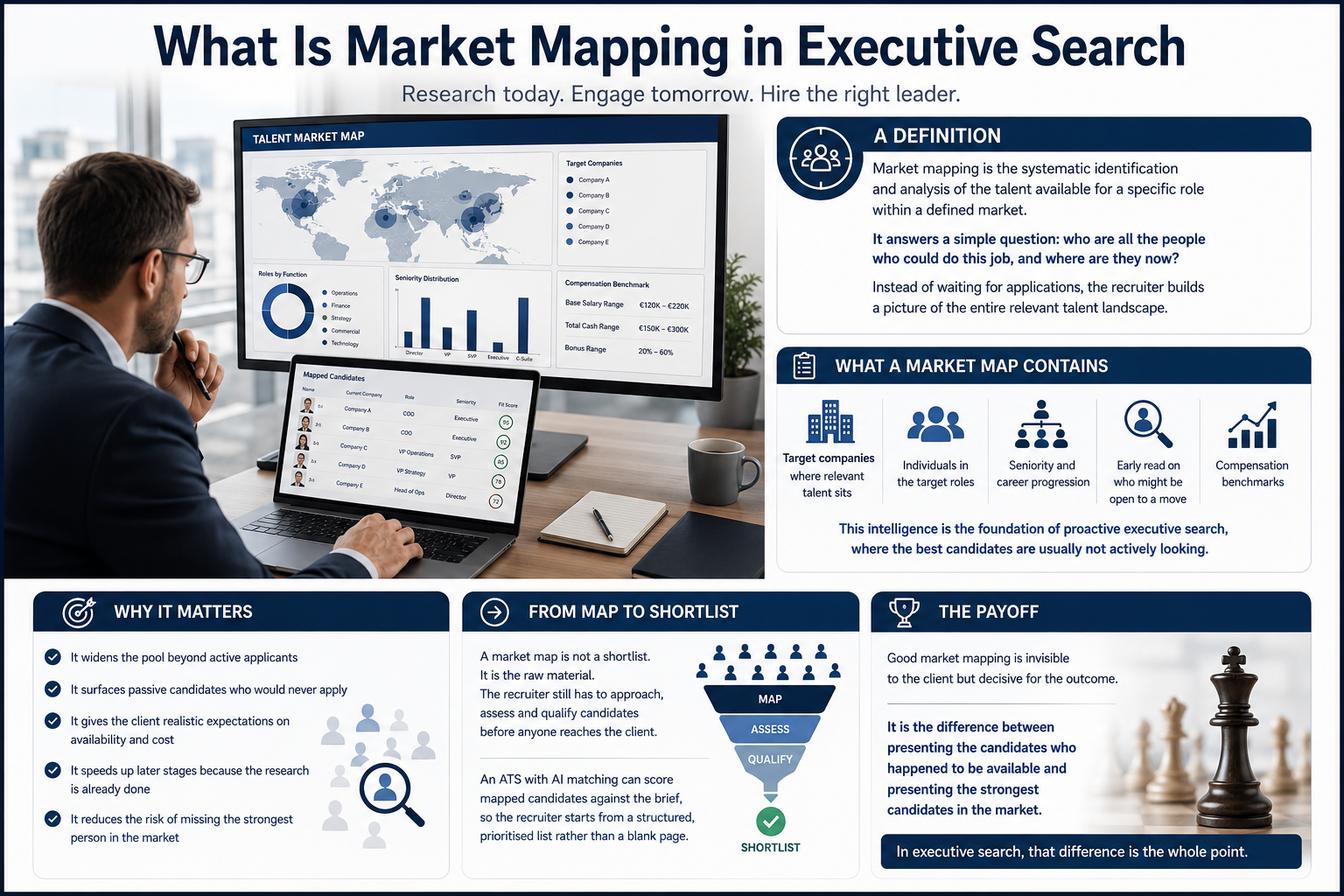
Market mapping is the systematic identification and analysis of the talent available for a specific role within a defined market. It answers a simple question: who are all the people who could do this job, and where are they now?
Instead of waiting for applications, the recruiter builds a picture of the entire relevant talent landscape.
A useful market map includes the target companies where relevant talent sits, the individuals in the target roles, their seniority and career progression, and an early read on who might be open to a move. It also reveals compensation benchmarks.
This intelligence is the foundation of proactive executive search, where the best candidates are usually not actively looking.
Market mapping delivers several advantages:
- it widens the pool beyond active applicants
- it surfaces passive candidates who would never apply
- it gives the client realistic expectations on availability and cost
- it speeds up later stages because the research is already done
- it reduces the risk of missing the strongest person in the market
A market map is not a shortlist. It is the raw material. The recruiter still has to approach, assess and qualify candidates before anyone reaches the client.
Modern tools help turn that research into action. An ATS with AI matching can score mapped candidates against the brief, so the recruiter starts from a structured, prioritised list rather than a blank page.
Good market mapping is invisible to the client but decisive for the outcome. It is the difference between presenting the candidates who happened to be available and presenting the strongest candidates in the market.
In executive search, that difference is the whole point.