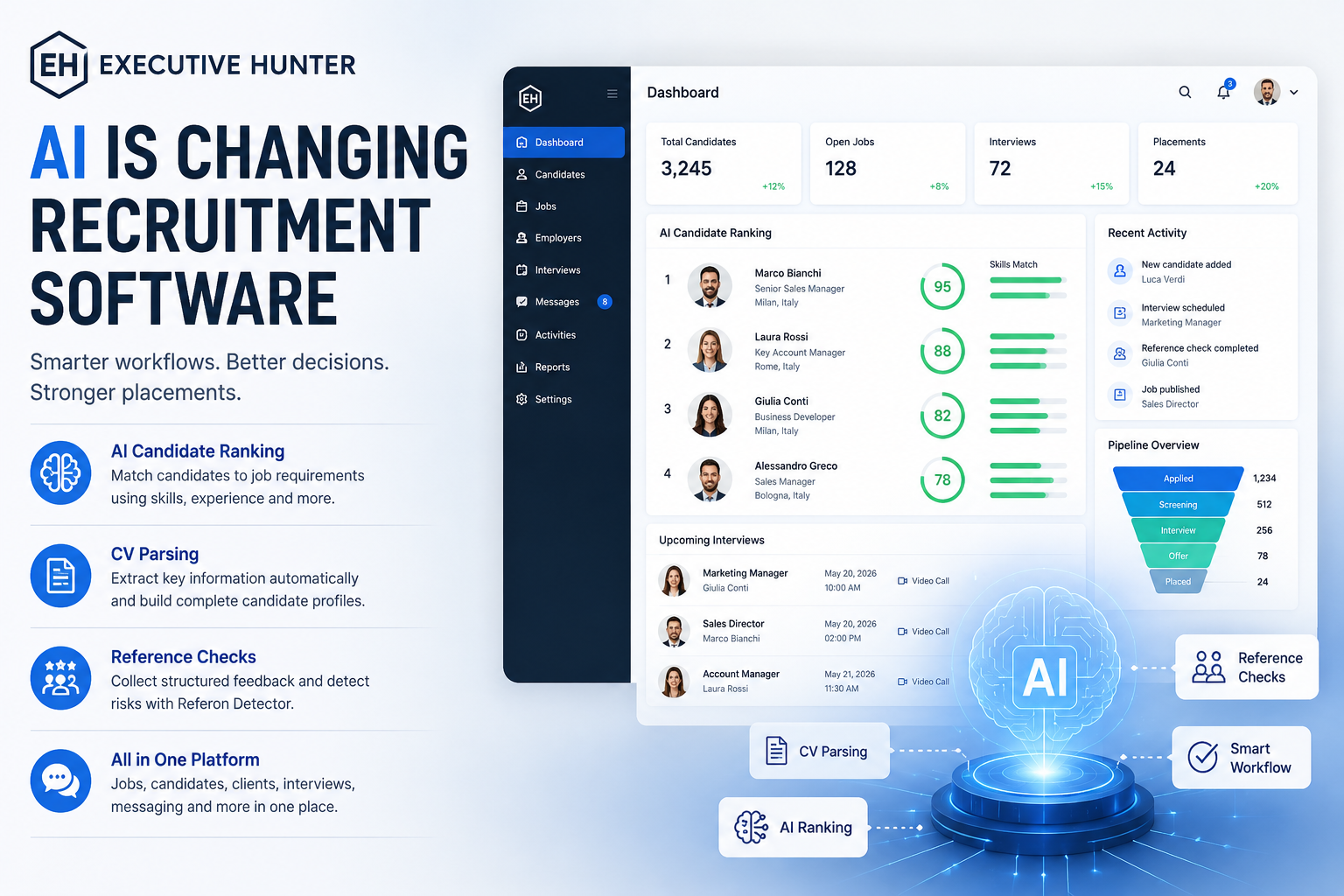
!AI recruitment workflow in Executive Hunter ATS
Recruitment has changed dramatically in recent years. Agencies no longer need only a database of candidates and clients. They need faster workflows, better information, cleaner communication and tools that help recruiters make decisions with more accuracy.
This is where AI-powered recruitment software becomes useful.
Traditional recruitment platforms often require recruiters to enter data manually, review every CV one by one and manage communication across too many disconnected tools.
Modern ATS platforms can reduce this workload by combining candidate management, job tracking, interview scheduling, messaging and automated screening in one environment. This is the approach behind Executive Hunter's executive search software, which brings these functions into a single workflow.
Instead of replacing recruiters, AI helps them spend less time on repetitive tasks and more time on valuable human work: evaluating fit, managing relationships and closing placements.
One of the most useful applications of AI in recruitment is candidate ranking.
AI can compare candidate profiles against job requirements by analysing skills, experience, education, location, salary expectations and other relevant criteria. This helps recruiters create stronger shortlists faster. In Executive Hunter this is handled by Juno AI, our candidate matching engine, which scores candidates against each role.
The result is not automatic hiring. The result is better prioritisation.
Recruiters remain in control, but they start from a clearer and more structured view of the available talent pool.
CV parsing is another important feature. Instead of manually copying information from a CV into a candidate profile, recruitment software can extract key information automatically.
This includes:
- personal details
- work experience
- education
- skills
- languages
- certifications
- salary expectations
- location preferences
Recruitment decisions become stronger when they include reliable reference information. Poor hiring decisions carry a real cost, which is why structured verification is worth the effort, as noted in SHRM guidance on talent acquisition.
Automated reference checking can help agencies collect feedback from referees, structure the answers and detect potential inconsistencies.
A system like Referon Detector can support recruiters by analysing competence, leadership, reliability, communication and culture fit. It can also help identify suspicious patterns such as duplicated IP addresses, unverified email domains or unusual writing similarities.
This gives recruiters another layer of information before presenting candidates to clients.
Recruitment agencies often struggle with software pricing models based on users, seats or paid add-ons.
A fixed-price ATS with unlimited users can be more practical for growing teams because agencies do not need to calculate the cost of every new recruiter, collaborator or manager.
This makes the platform easier to adopt and easier to scale.
AI is not replacing recruitment professionals. It is changing the way they work.
The agencies that benefit most are not the ones that use AI blindly. They are the ones that use it to remove friction, improve data quality and make faster, better-informed decisions.
Executive Hunter is designed for this new recruitment workflow: candidate management, client management, job tracking, AI ranking, CV parsing, reference checks, candidate portal and collaboration tools in one platform. See how it works.