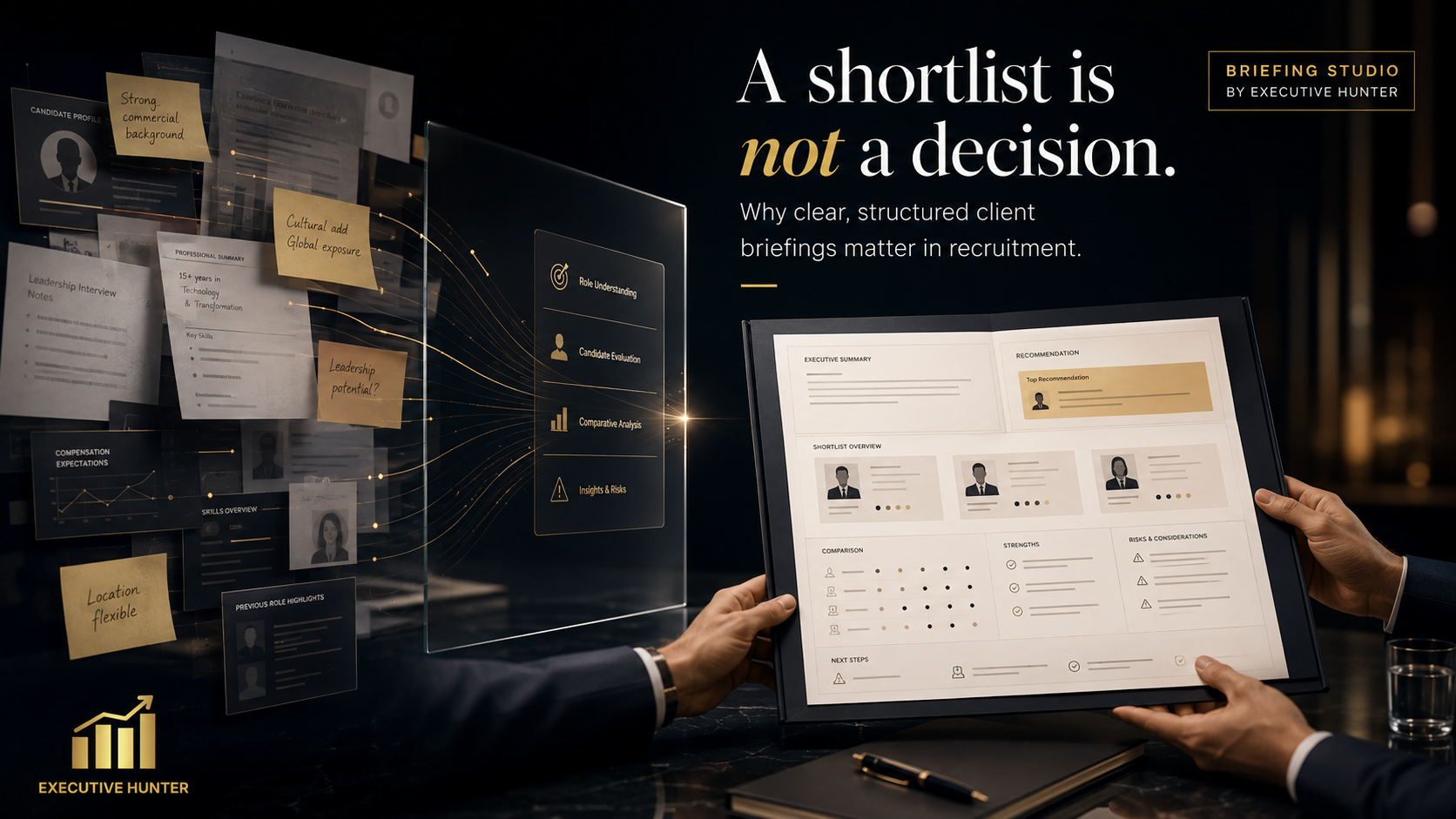
Why clear, structured client briefings matter in recruitment
In recruitment, the shortlist is often treated as the final product.
The search has been run. Candidates have been identified. Interviews have taken place. Profiles have been reviewed.
And then the client receives a list of names.
But for the client, that is rarely the end of the process. In many cases, it is where the most important part begins: understanding the difference between the candidates and deciding who is truly the right fit.
A shortlist can show who is available, interested and qualified. It does not automatically explain who is strongest, where the risks are, how the candidates compare, or why one person should move forward over another.
That is the role of the briefing.
Recruiters collect a large amount of information during a search: CVs, interview notes, salary expectations, career history, motivations, availability, references, communication style, leadership signals, concerns, strengths and market context.
Much of that information is valuable. But value can be lost when it is scattered across emails, notes, attachments, spreadsheets and separate conversations.
A client may receive three strong profiles and still be left with unclear questions: Who best matches the brief? What evidence supports the recommendation? Which gaps are manageable? Where is the risk? How do these candidates compare side by side? What is the recruiter's view?
This is especially important in executive search and senior recruitment, where the decision is rarely based on technical fit alone.
Clients are not only evaluating experience. They are assessing leadership judgement, culture fit, commercial impact, risk, timing and long-term value. That requires more than a candidate summary. It requires structure.
Consider a typical senior hiring process.
A client receives three finalist profiles. All three appear credible. One has the strongest sector experience. Another has the best leadership record. The third may be the most culturally aligned but has less direct exposure to the client's market.
On paper, all three can be justified. Without a structured briefing, the client has to do much of the comparison work alone.
They may focus too heavily on the best-known employer brand, the most polished interview performance, or the most familiar career path. Important context may be missed. A candidate's risk may be exaggerated. Another candidate's potential may be underexplained.
The recruiter may already have the right judgement. But unless that judgement is presented clearly, the client may not see the decision path.
This is where the quality of the presentation changes the value of the search.
A good recruiter does not simply forward profiles. They interpret.
They explain why a candidate is relevant, where the match is strong, where the concerns sit, and what the client should consider before moving forward. That interpretation is one of the most important parts of the recruiter's work. But it must be visible.
A clear client briefing helps translate recruiter judgement into something the client can understand, challenge and act on. It connects the original brief to the evidence gathered during the search. It gives shape to the comparison between finalists. It separates fact from interpretation. It makes risks easier to discuss. It makes recommendations easier to trust.
And, importantly, it helps the client feel that the process has been rigorous, not improvised.
There is sometimes a concern that structured reporting makes recruitment feel mechanical. In reality, the opposite is true.
Good structure gives expert judgement a stronger frame. A well-presented briefing does not replace the recruiter's experience. It helps organise that experience into a clearer narrative.
It allows the client to see:
- how each candidate matches the brief
- where the strongest evidence sits
- how finalists compare across key criteria
- what concerns should be explored further
- which candidate is recommended, and why
Recruitment is becoming more complex, not less.
Clients expect speed, but they also expect quality. They want strong candidates quickly, but they also want confidence in the recommendation.
At the same time, recruitment teams are working across more tools, more data points and more communication channels than ever before. The risk is fragmentation. Information exists, but not always in one place. Insights are captured, but not always presented clearly. Candidate comparisons are made, but not always documented in a way the client can use.
In that environment, the client briefing becomes more than an administrative document. It becomes a decision tool.
This is the thinking behind Briefing Studio inside Executive Hunter.
Briefing Studio was designed to help recruiters turn finalist shortlists into clear, structured, client-ready briefings. It brings together the elements that often sit separately in a recruitment process: candidate summaries, suitability analysis, comparison tables, recruiter notes, recommendation sections and interview intelligence.
The aim is not to make the recruiter less central. It is to make the recruiter's judgement clearer.
Because a strong shortlist deserves more than a collection of CVs and notes. It deserves a structured explanation of why those candidates matter, how they compare, and what the client should consider next.
In many recruitment processes, the candidate presentation is still treated as a final task. Something to assemble once the "real" work is done.
But the presentation is part of the real work. It is the moment where research, assessment, interviews and recruiter judgement are translated into a client decision.
When that moment is clear, structured and well presented, clients move with more confidence. When it is fragmented, even strong candidates can lose impact.
A shortlist may open the conversation. But the briefing helps the client decide. And in recruitment, that difference matters.